Text
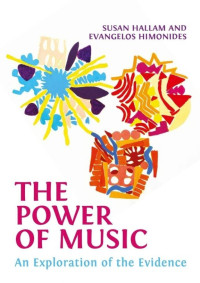
The Power of Music
Author Biographies (xiii) [Susan Hallam (xiii), Evangelos Himonides (xiv)] | Preface (xvii) | 1. Introduction (1) [Music, Its Functions and Origins (2), Transfer of Learning (7), Methodological Issues (9), Ways of Engaging with Music and Varying Levels of Commitment (11), Music Therapy (13), Interpreting the Research Findings (13)] | 2. Music and Neuroscience (15) [Neuroscientific Methods (17), Changes in the Brain following Musical Activity (18), Comparisons between Musicians’ and Non-Musicians’ Expertise (19), The Automation of Skills as Expertise Increases (25), Bimanual Motor Coordination (26), Multisensory Learning (29), Neurological Differences Relating to Genre and the Instrument Played (30), Studies with Child Musicians and Non-Musicians (33), Genetic and Maturational Effects versus Training Effects (37), Intervention Studies (38), Overview (42)] | 3. Aural Perception and Language Skills (43) [Explanations of the Relationships between Music and Language (46), Comparisons between Musicians and Non-Musicians (55), Research with Children (62), Research with those with Auditory or Language Impairments (72), Overview (77)] | 4. Literacy and Related Language Skills (79) [Correlation Studies and Comparisons between Musicians and Non-Musicians (80), Intervention Studies (83), Children Facing Challenges with Literacy Skills (90), Are Pitch or Rhythm Programmes More Effective in Enhancing Literacy? (96), Reviews, Meta-Analyses and Conclusions (101), Spelling (102), Writing (103), Overview (105)] | 5. Music, Spatial Reasoning and Mathematical Performance (107) [Comparisons between Musicians and Non-Musicians, and Correlation Studies (110), Musical Interventions and Spatial-Temporal Reasoning (114), The Relationships between Spatial Skills and Mathematics (119), The Relationships between Music, Spatial Skills and Mathematics (122), Musical Engagement and Mathematical Performance (123), Overview (130)] | 6. The Impact of Musical Engagement on Memory (133) [Visual Memory (134), Research with Children (140), Verbal Memory (141), Research with Children (145), Working Memory (148), Research with Adults (149), Research with Children and Young People (154), Older Adults (159), Reviews and Meta-Analyses (167), Overview (169)] | 7. Executive Functioning and Self-Regulation (171) [Research with Adults (175), Research with Children (181), Research with Older People (190), Reviews of the Literature (194), Overview (197)] | 8. Intellectual Development (199) [Nature or Nurture (201), Correlational and Comparative Research with Adults (202), Correlation and Comparative Research with Children (206), Intervention Studies (210), Music and Emotional Intelligence (215), Studies with Older Adults (217), Reviews and Meta-Analyses (219), Overview (221)] | 9. Musicians and Creativity (223) [Neurological Studies of Creativity (225), Correlational and Comparative Research on Musicians (227), The Personality of Musicians and Creativity (230), Intervention Studies (232), Creativity in Later Life (234), Reviews and Meta-Analyses (235), Overview (235)] | 10. General Attainment (237) [Correlation and Comparative Studies (237), Large-Scale Research (241), Research with Disadvantaged Populations (247), Intervention Research (248), Reviews and Meta-Analyses (251), Explanations for the Research Findings (253), Neurological Studies (254), Length of Engagement with Music (255), Type, Nature and Quality of Musical Training (256), The Role of Executive Functions in Attainment (257), Personality Factors (257), Motivation (258), Overview (259)] | 11. Music and Studying (261) [Listening to Music prior to Completing a Task (261), Background Music (269), The Nature of the Music (270), Preferred Music, Familiarity and Liking (276), Preference for Music of One’s Own Culture (279), The Nature of the Task To Be Completed (279), Background Music and Memory (279), Background Music and Attention (284), Reading Comprehension (286), Second-Language Learning (288), Background Music and English as a Second Language (289), Individual Differences (290), Musical Expertise (290), Gender (292), Personality (292), Background Music and Metacognition (294), The Impact of Background Music on Children’s Behaviour and Task Performance (296), Background Music and Primary-School Children (297), Background Music and Older Students (300), Research with Children with Emotional and Behavioural Difficulties, ADHD and Developmental Difficulties (301), Children with Attention Deficit Hyperactivity Disorder and Attention Deficit Order (301), Emotional and Behavioural Difficulties (303), Older Adults and those with Cognitive Impairment (304), Reviews and Meta-Analyses (307), Explaining the Impact of Background Music on Cognitive Performance (309), An Explanatory Framework (316), Overview (317)] | 12. Re-Engagement and Motivation (319) [Motivation (319), Motivation Developed through Engagement with Music (322), Children and Young People Facing Challenging Life Circumstances (325), El Sistema and Sistema-inspired Programmes (326), Raised Aspirations and Motivation for Learning (326), Self-Beliefs (331), School Attendance and Positive Attitudes towards School (332), Emotional and Behavioural Difficulties (333), Transferable Skills (334), Music Interventions Unrelated to El Sistema (334), School Attendance and Attitudes towards School (339), The Integration of Young People with Special Educational Needs into Mainstream Education (340), School-Based Music Therapy Interventions for Children with Emotional and Behavioural Difficulties (342), The Role of Rap and Hip Hop in Therapy in School Contexts (347), Music Programmes for Young Offenders (353), Music Programmes for Adult Offenders (361), Choirs (362), Projects Using Gamelan (363), Assorted Music Therapies (365), Overview (372)] | 13. Personal, Social and Physical Development (375) [Personal Development (375), Music and Identity (375), Music and Personality (377), Self-Beliefs (384), Self-Beliefs, Deprivation and Disaffection (387), Children with Special Educational Needs and Disabilities (389), Ensemble Participation (390), Musical Preferences and Self-Esteem (391), Social Development (392), Musical Ensembles and Teamwork (397), School Climate (400), Sistema Programmes (401), Prosocial Skills and Empathy (403), Interventions for Children with Special Educational Needs and Disabilities (405), Physical Development (406), Music, Locomotor Performance and Coordinated Motor Skills (408), Overview (410)] | 14. Psychological Wellbeing (413) [The Use of Music to Support Emotional Stability and Manage Moods (418), Singing (425), Wellbeing in Young Children (430), Music and Wellbeing in School-Aged Participants (432), Music and Wellbeing in Adolescents and Young People (437), Actively Making Music (444), Music and Wellbeing in Adults (447), Participation in Musical Activities (449), Attendance at Music Festivals (451), Music and Wellbeing in the Older Generation (453), Music, Wellbeing and the COVID-19 Pandemic (465), The Impact of the Pandemic on Music Professionals (475), Overview (477)] | 15. Music and Physical and Mental Health (479) [The Role of Music in Psychological and Physical Health (480), Music, Stress and the Immune System (484), Active Music-Making and the Promotion of General Good Health (486), Music, Health and the Older Generation (488), Music, Dementia and Care in the Home (497), Reviews of the Relationship between Music Therapy and Dementia (499), Music, Public Health and Music on Prescription (501), The Role of Community Music and Creative Workshops (503), Music, Brain Plasticity and Movement (505), Breathing (509), Speech Impairment (510), Music in Hospital Settings (511), Music and Mental Health: Stress, Anxiety and Depression (519), Mental Health Care in Children, Adolescents and Young People (523), Insomnia (525), Music, Trauma and Abuse (527), Severe Mental Ill-Health (538), Overview (549)] | 16. Music, Inclusion and Social Cohesion (551) [Music and Conflict (555), Music and Refugees (560), Social Inclusion (566), Overview (571)] | 17. Music in Everyday Life (573) [Music and Leisure (574), Listening to Music (576), Attending Live Musical Events (577), Actively Making Music (578), Socioeconomic Status (579), Music in the Arts (581), Listening to Support Everyday Activities (581), Music and Driving (582), Music at Work and to Accompany Mental Activity (583), Music and Exercise (584), Music, Commerce and Consumption (585), The Economics of Music (588), Music and Non-Human Species (589), Overview (591)] | Reflections on an Exploration of the Evidence for the Power of Music (593) | Bibliography (597) | Index (805)
Availability
Detail Information
- Series Title
-
-
- Call Number
-
781.11 Sus t
- Publisher
- Cambridge : OpenBook Publisher., 2022
- Collation
-
xvii, 846 hlm. : 23,4 x 15 cm
- Language
-
English
- ISBN/ISSN
-
978-1-800-64418-2
- Classification
-
781.11
- Content Type
-
-
- Media Type
-
-
- Carrier Type
-
-
- Edition
-
-
- Subject(s)
- Specific Detail Info
-
-
- Statement of Responsibility
-
-
Other version/related
No other version available
File Attachment
Comments
You must be logged in to post a comment
 Computer Science, Information & General Works
 Philosophy & Psychology
 Religion
 Social Sciences
 Language
 Pure Science
 Applied Sciences
 Art & Recreation
 Literature
 History & Geography