Text
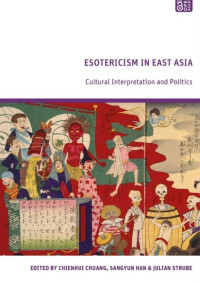
Esotericism in East Asia: Cultural Interpretation and Politics
Contents\\\\r\\\\n\\\\r\\\\nList of Illustrations vii\\\\r\\\\nAcknowledgments viii\\\\r\\\\nNote to the Reader x\\\\r\\\\nNotes on Contributors xi\\\\r\\\\nIntroduction: What Is “Esotericism” in East Asia? Historical and\\\\r\\\\nMethodological Perspectives 1\\\\r\\\\nChienhui Chuang, Sangyun Han, and Julian Strube\\\\r\\\\nPart 1 Naming and Framing the “Esoteric” and “Occult”\\\\r\\\\n1 Darkness, Strangeness, and Monstrosity: The Affectiveness of\\\\r\\\\nKaii in Japanese Studies of the “Occult” 33\\\\r\\\\nIoannis Gaitanidis\\\\r\\\\n2 Western Esotericism with Chinese Characteristics: Translations\\\\r\\\\nand Translators in the People’s Republic 53\\\\r\\\\nDavide Marino\\\\r\\\\n3 The Heresy of History: The Category of Gishi in Modern Japanese\\\\r\\\\n(Oc)culture 79\\\\r\\\\nOrion Klautau\\\\r\\\\n4 Who Talks About Esoteric Shinto, and Why? 105\\\\r\\\\nAvery Morrow\\\\r\\\\n5 For Now We See Through a Distorted Lens, Darkly: In Search of\\\\r\\\\nBuddhist Masters 125\\\\r\\\\nToshio Akai\\\\r\\\\n6 Delineating the “Esoteric”: The Development of the “Identity of\\\\r\\\\nthe Purport of Perfect and Esoteric Teachings” (enmitsu itchi) in\\\\r\\\\nMedieval Tendai Buddhism 153\\\\r\\\\nTakahiko Kameyama\\\\r\\\\n\\\\r\\\\nPart 2 Reconfiguring Esotericism Through Politics and Transnationalism\\\\r\\\\n7 The Theosophical Movement and Asian Unity: Perspectives from\\\\r\\\\nPrewar China and Japan 175\\\\r\\\\nChienhui Chuang\\\\r\\\\n\\\\r\\\\n8 Japan’s Occult Monsters: Esotericism and the New Left in Post-\\\\r\\\\n1960s Japan 199\\\\r\\\\n\\\\r\\\\nHidehiko Kurita\\\\r\\\\n9 The Transformation of Korean Tanhak Through Globalization: The\\\\r\\\\nNew Age Movement and the Worldwide Expansion of Dahn World 231\\\\r\\\\nMitsuaki Sassa\\\\r\\\\n10 The Healing Spirit in Korea 253\\\\r\\\\nJames Flowers\\\\r\\\\nNotes 285\\\\r\\\\nIndex 301
Availability
Detail Information
- Series Title
-
-
- Call Number
-
306.695 Chi e
- Publisher
- London : Bloomsbury Publishing (UK)., 2026
- Collation
-
xi, 320 hlm. : 23,5 x 15 cm
- Language
-
English
- ISBN/ISSN
-
978-1-350-55752-9
- Classification
-
306.695
- Content Type
-
-
- Media Type
-
-
- Carrier Type
-
-
- Edition
-
-
- Subject(s)
- Specific Detail Info
-
-
- Statement of Responsibility
-
-
Other version/related
No other version available
File Attachment
Comments
You must be logged in to post a comment
 Computer Science, Information & General Works
 Philosophy & Psychology
 Religion
 Social Sciences
 Language
 Pure Science
 Applied Sciences
 Art & Recreation
 Literature
 History & Geography