Text
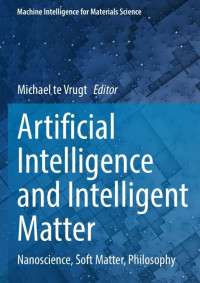
Artificial Intelligence and Intelligent Matter
Introduction: Artificial Intelligence and Intelligent Matter ............\\\\r\\\\nMichael te Vrugt \\\\r\\\\nFundamental Concepts in Artificial Intelligence \\\\r\\\\nIntroduction to Artificial Intelligence ................................\\\\r\\\\nTobias Wand \\\\r\\\\nAn Introduction to Reinforcement Learning–in Artificial \\\\r\\\\n1 \\\\r\\\\n9 \\\\r\\\\nand Biological Control Systems ..................................... 35 \\\\r\\\\nMalte Schilling \\\\r\\\\nAn Introduction to Reservoir Computing ............................ 53 \\\\r\\\\nMichael te Vrugt \\\\r\\\\nApplications of Artificial Intelligence to Nanosystems \\\\r\\\\nLearning Dynamical Systems from Data ............................. 69 \\\\r\\\\nOliver Kamps, Tim W. Kroll, and Oliver Mai \\\\r\\\\nMachine Learning Approaches to Classical Density Functional \\\\r\\\\nTheory ........................................................... 83 \\\\r\\\\nAlessandro Simon and Martin Oettel \\\\r\\\\nMachine Learning in Quantum Density Functional Theory ............ 115 \\\\r\\\\nThorsten Deilmann \\\\r\\\\nGenerative Deep Learning for the Inverse Design of Materials ......... 127 \\\\r\\\\nYixuan Zhang, Teng Long, and Hongbin Zhang \\\\r\\\\nMachine Learning for Identifying Dynamical Phases in Topological \\\\r\\\\nLasers ............................................................ 167 \\\\r\\\\nStephan Wong, Doris E. Reiter, and Sang Soon Oh\\\\r\\\\nContents\\\\r\\\\nArtificial Intelligence Reshaping the Semiconductor Metrology ........ 189 \\\\r\\\\nMd. Ashiqur Rahman Laskar, Srijan Chakrabarti, and Umberto Celano \\\\r\\\\nMachine Learning for Active Matter ................................ 217 \\\\r\\\\nGiovanni Volpe \\\\r\\\\nImplementations of Artificial Intelligence in Nanosystems \\\\r\\\\nA Primer on Neuromorphic Hardware: Underlying Principles \\\\r\\\\nand Approaches—From Sensors to Processors ....................... 241 \\\\r\\\\nAkhilesh Jaiswal, Md. Abdullah-Al Kaiser, and Maryam Parsa \\\\r\\\\nTowards Intelligent Active Particles ................................. 257 \\\\r\\\\nHartmut Löwen and Benno Liebchen \\\\r\\\\nIntelligent Matter Consisting of Active Particles ...................... 273 \\\\r\\\\nJulian Jeggle and Raphael Wittkowski \\\\r\\\\nNeural Networks Consisting of DNA ................................ 289 \\\\r\\\\nMichael te Vrugt \\\\r\\\\nIntelligence Without a Brain—Perspectives from the Aneural \\\\r\\\\nSlime Mold as a Computing Model for Artificial Intelligence .......... 303 \\\\r\\\\nJannes Freiberg and Roshani Madurawala \\\\r\\\\nIntegrated Photonics for Neuromorphic Computing .................. 331 \\\\r\\\\nLennart Meyer, Rongyang Xu, and Wolfram Pernice \\\\r\\\\nTime-multiplexed Reservoir Computing with Semiconductor \\\\r\\\\nLaser Systems ..................................................... 371 \\\\r\\\\nKathy Lüdge and Lina Jaurigue \\\\r\\\\nNeuromorphic Spintronics ......................................... 389 \\\\r\\\\nAtreya Majumdar and Karin Everschor-Sitte \\\\r\\\\nMachine Learning with Quantum Computers ........................ 417 \\\\r\\\\nIvana Nikoloska \\\\r\\\\nPhilosophical Aspects \\\\r\\\\nNormativity and the Intelligent Matter Framework ................... 437 \\\\r\\\\nBarnaby Crook \\\\r\\\\nWhat is It like to Be a Nail?—The Intentions of Matter ............... 463 \\\\r\\\\nChristian Kaernbach \\\\r\\\\nRethinking Computational Implementation Through Symphoria ...... 473 \\\\r\\\\nLuis G. Lopez \\\\r\\\\nEthical Aspects of Artificial Intelligence in Nanoscience ............... 493 \\\\r\\\\nJohn Weckert
Availability
Detail Information
- Series Title
-
-
- Call Number
-
620.5 Mic a
- Publisher
- Switzerland : Springer Nature Switzerland., 2026
- Collation
-
x, 493 hlm. : 24 cm.
- Language
-
English
- ISBN/ISSN
-
978-3-032-04128-9
- Classification
-
620.5
- Content Type
-
-
- Media Type
-
-
- Carrier Type
-
-
- Edition
-
-
- Subject(s)
- Specific Detail Info
-
-
- Statement of Responsibility
-
-
Other version/related
No other version available
File Attachment
Comments
You must be logged in to post a comment
 Computer Science, Information & General Works
 Philosophy & Psychology
 Religion
 Social Sciences
 Language
 Pure Science
 Applied Sciences
 Art & Recreation
 Literature
 History & Geography